They count up from the bottom line for every note.
Book 1 teaches three landmark notes: Middle C, Treble G and Bass F. Every other note is read as a step or a skip from the nearest landmark, so children stop counting lines.
Book 1Piano Quest is a ten-book workbook series for young pianists. Each page teaches one small idea, practices it in a game, and brings older notes back so they stick. It takes 5–10 minutes a day at home, or works as ready-made homework between lessons.
The free sample is Book 1's first two levels, complete, with the answer key. A PDF, no sign-up.
 Answer key in every book
Each answer below is printed in the books, page by page.
They count up from the bottom line for every note.
Book 1 teaches three landmark notes: Middle C, Treble G and Bass F. Every other note is read as a step or a skip from the nearest landmark, so children stop counting lines.
Book 1They forget last week's notes.
Older notes come back on every checkpoint, in the games and in mixed review pages, so recall is practiced on purpose, not left to chance.
Every bookA new note and a new rhythm arrive together.
One new thing at a time. In Books 3 and 4 the note range stays the same while rhythm is taught, so a child never has to decode a new note and a new rhythm at once.
Books 3 and 4Homework takes you time to prepare.
Each level is ready to hand out: a worked example, a few practice pages and a checkpoint with a score box. Assign one level, then check it at the next lesson.
Every bookParents want to help but don't read music.
An answer key at the back lets any adult check the written work. In the ear-training book, a printed card tells the adult exactly what to play or clap.
Every book · Book 8Printing for a whole studio adds up.
Every PDF comes with a teacher license: buy it once for $7.99 and print as many copies as your own students need.
PDF editionChildren always know what to do next, and so does the adult helping them. These pages are from Book 1. Click any page to see it full size.
Each level opens with its new idea and a worked example, before any practice.
Every note the child names on the staff is also found on the piano keyboard.
Mazes, bingo and treasure hunts bring earlier notes back, so they are not forgotten.
A short checkpoint with a score box ends the level. Then the child colors the badge.
A page-by-page look at Book 1, the whole series and the new Christmas book:
The video has no sound. Captions explain each page.
Get the free sampleDownload, print and use them. There is no email to enter and nothing to sign up for.
You are welcome to pass the samples on to other teachers and parents, unchanged.
Books 1–5 build reading, rhythm and chords, in order. Books 6–10 each train one skill, and a child can start any of them once ready. Click a cover to look inside.
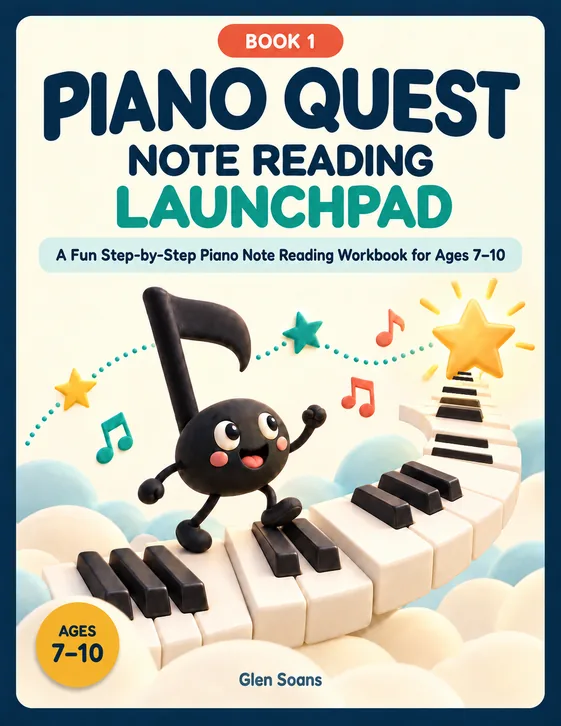
Reading notes from three landmarks, on the staff and on the keyboard.
Start here if: New to reading notes.
The whole grand staff, F♯, C♯, B♭ and E♭, and fourths and fifths read by shape.
Start here if: Reads the notes near Middle C.
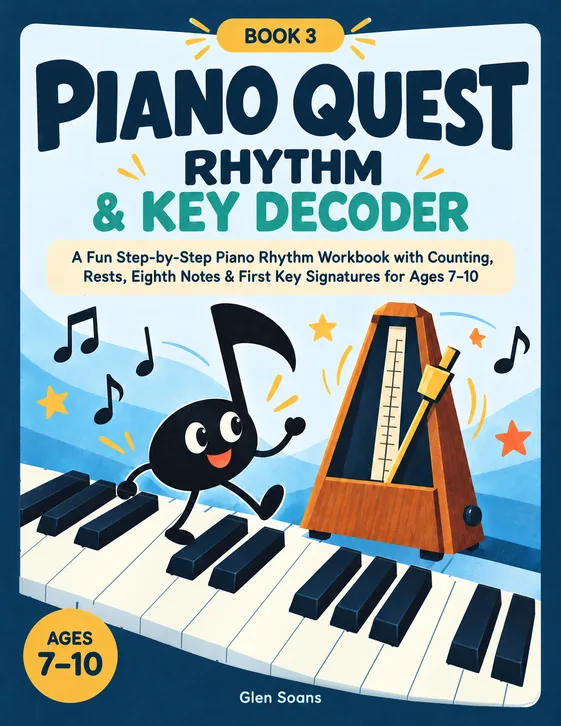
Counting, rests, eighth notes, ties, and the keys of G and F major.
Start here if: Reads notes on the grand staff.
Dotted rhythms, 6/8, pickup notes, D and B♭ major, and first pieces with both hands.
Start here if: Counts confidently and reads the grand staff.
Scales, major and minor chords, I–IV–V accompaniment and transposing.
Start here if: Plays a short piece with both hands.
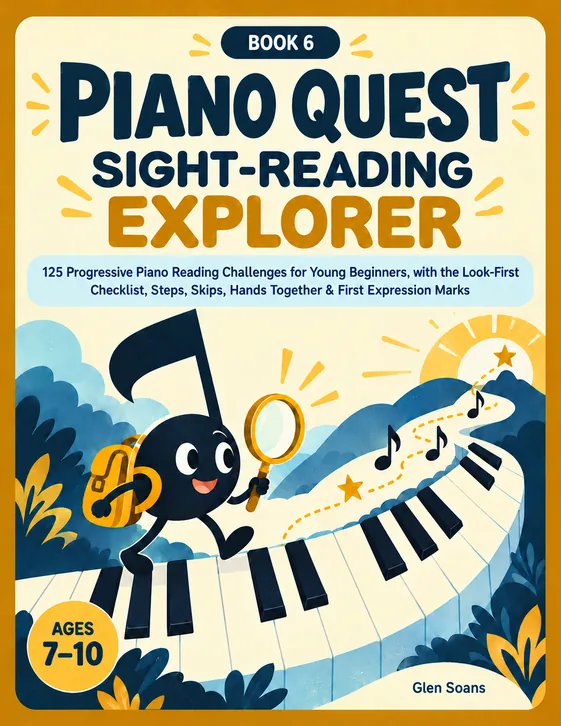
125 short pieces read at first sight, with an 8-point Look-First Checklist.
Start here if: Reads both clefs and counts simple rhythms.
Whole and half steps, intervals, major scales, key signatures and triads.
Start here if: Ages 7 and up, after Books 1–6 or similar.
Pitch, rhythm, intervals, chords and melody memory. A printed card tells the adult what to play.
Start here if: Reads basic notation. No audio or app needed.
Posture, relaxed finger patterns, legato and staccato, first scales and chords.
Start here if: Any beginner, beside any method.
Improvising, writing rhythms and melodies, and composing a first complete piece.
Start here if: Plays simple pieces.
Piano Quest isn't a method book. It is the practice that sits beside your method, whatever you teach from.
| Your student is new to reading notes | Book 1 |
|---|---|
| Your student reads the notes near Middle C | Book 2 |
| Your student reads the grand staff and needs counting and rhythm | Book 3 |
| Your student counts confidently and reads the grand staff | Book 4 |
| Your student reads both staves, knows the G, F, D and B♭ key signatures, and plays a short piece hands together | Book 5 |
| Your student needs one skill: sight-reading, theory, ear training, technique or composing | Books 6–10 |
Buy a PDF once and print as many copies as your own students, classes or children need. Each teacher needs their own copy, so please don't share the file or post it online. For a studio with several teachers, or a school, write to us.
US Letter PDFs that also print on A4. The answer key is at the back of every book.
Buy the PDFsEvery book is also a paperback on Amazon (8.5 × 11 in), so parents can order their child's copy themselves.
See the paperbacks on AmazonAsk about a book or the license: email us.
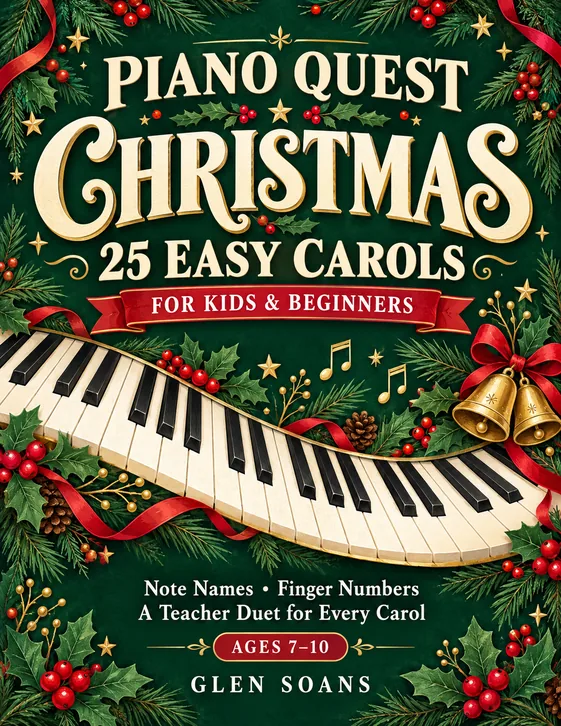
The carols students want to play in December, in five levels that grow step by step. Every note shows its letter name inside the note head, finger numbers guide each hand, and a "start here" keyboard picture shows where each finger begins.
The 25 carols: Jingle Bells, Carol of the Bells, Joy to the World, We Wish You a Merry Christmas, Good King Wenceslas, Away in a Manger, O Come, O Come, Emmanuel, Silent Night, We Three Kings, O Christmas Tree, The Holly and the Ivy, Deck the Halls, God Rest Ye Merry, Gentlemen, Angels We Have Heard on High, Go Tell It on the Mountain, Hark! The Herald Angels Sing, O Come, All Ye Faithful, I Saw Three Ships, O Little Town of Bethlehem, Once in Royal David's City, Coventry Carol, In the Bleak Midwinter, It Came Upon the Midnight Clear, What Child Is This? and Ding Dong Merrily on High.
Jingle Bells, from the free sample: the student part on top, the teacher duet on the smaller staves underneath.
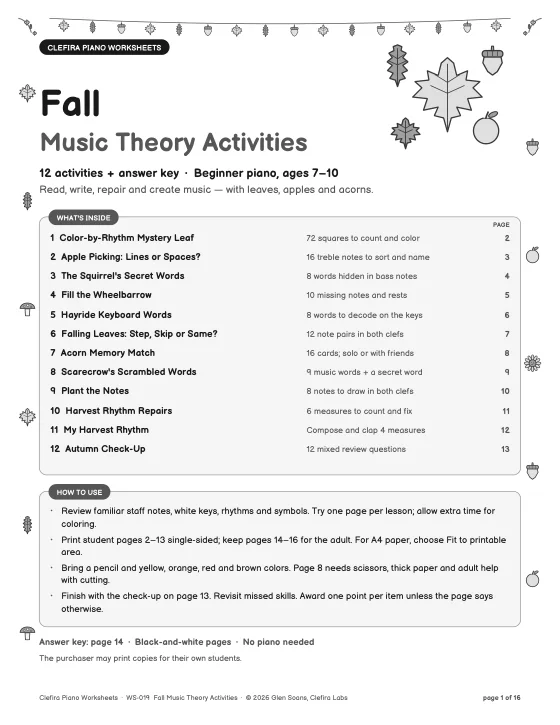
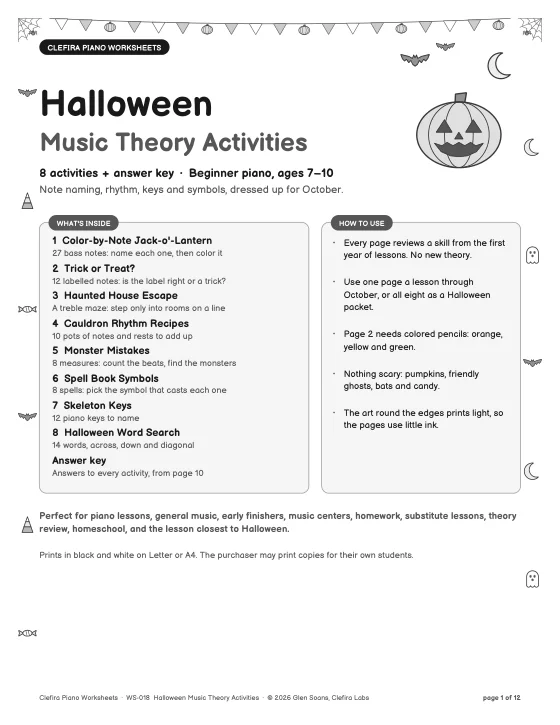
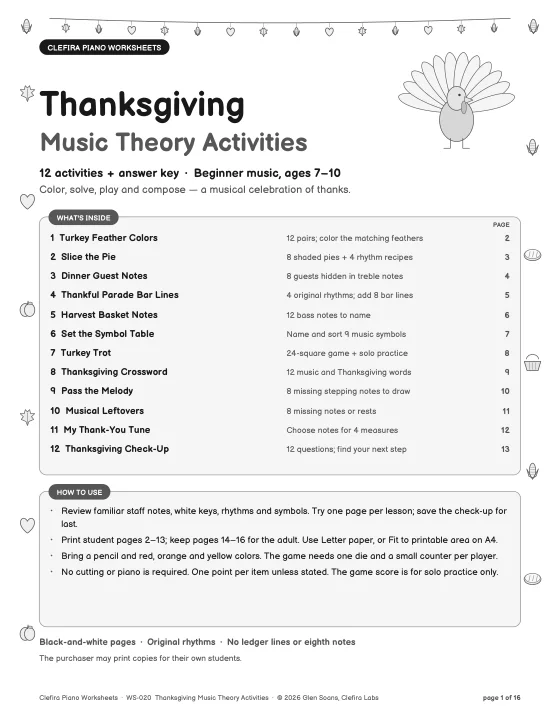
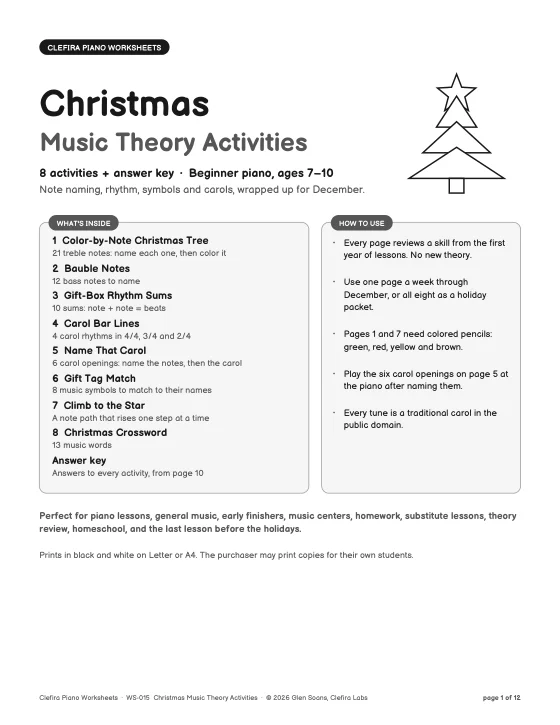
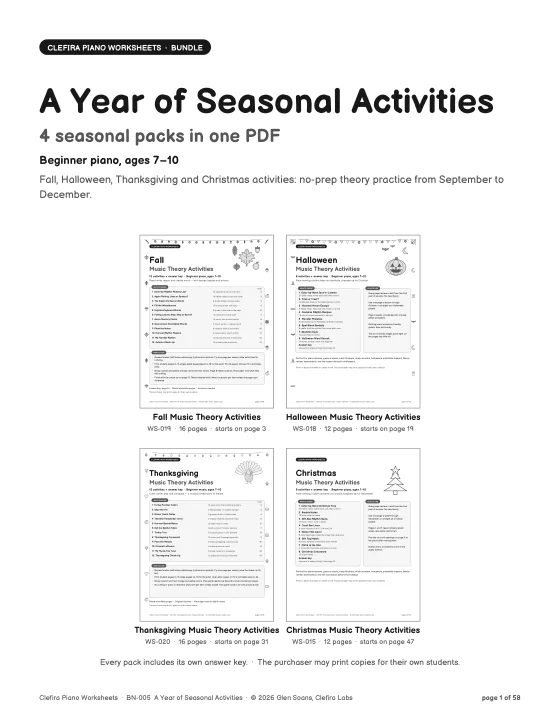
Clefira Piano Worksheets: short printable packs for fall, Halloween, Thanksgiving and Christmas, sold at the same shop with the same teacher license.
or $29.99 for Books 1–5 or Books 6–10
printed and shipped by Amazon
No. Piano Quest is a workbook series that sits beside any method or lesson plan. Books 1–5 build reading, rhythm and chords in order. Books 6–10 each train one skill: sight-reading, theory, ear training, technique and composing.
Book 1 for a child who is new to reading notes. Books 1 to 5 build on each other in order. Books 6 to 10 each train one skill after the core course. The table under For teachers shows where a student should start.
Yes, from the PDF edition. You may print as many copies as your own students, your own classes or your own children need. Please do not share the file with other teachers, post it online or put it on a shared drive. Each teacher needs their own copy.
The whole workbook as one printable PDF, with its answer key at the back, ready to download from your library as soon as payment clears. A set gives you each of its five books as its own PDF. Nothing is shipped.
No. Everything is on the page. Even the ear-training book (Book 8) prints a helper card for each exercise, so the adult reads it and plays or claps the clue.
Yes. The pages are US Letter size and print on Letter or A4.
Children aged 7–10 in their first years of piano. Book 7, the theory book, also suits older beginners.
Yes. There is no email to enter and nothing to sign up for. Print it, use it with your students, and pass it on unchanged if you like.
Download the Book 1 sample, try it with one student for a week, and see how they get on.